

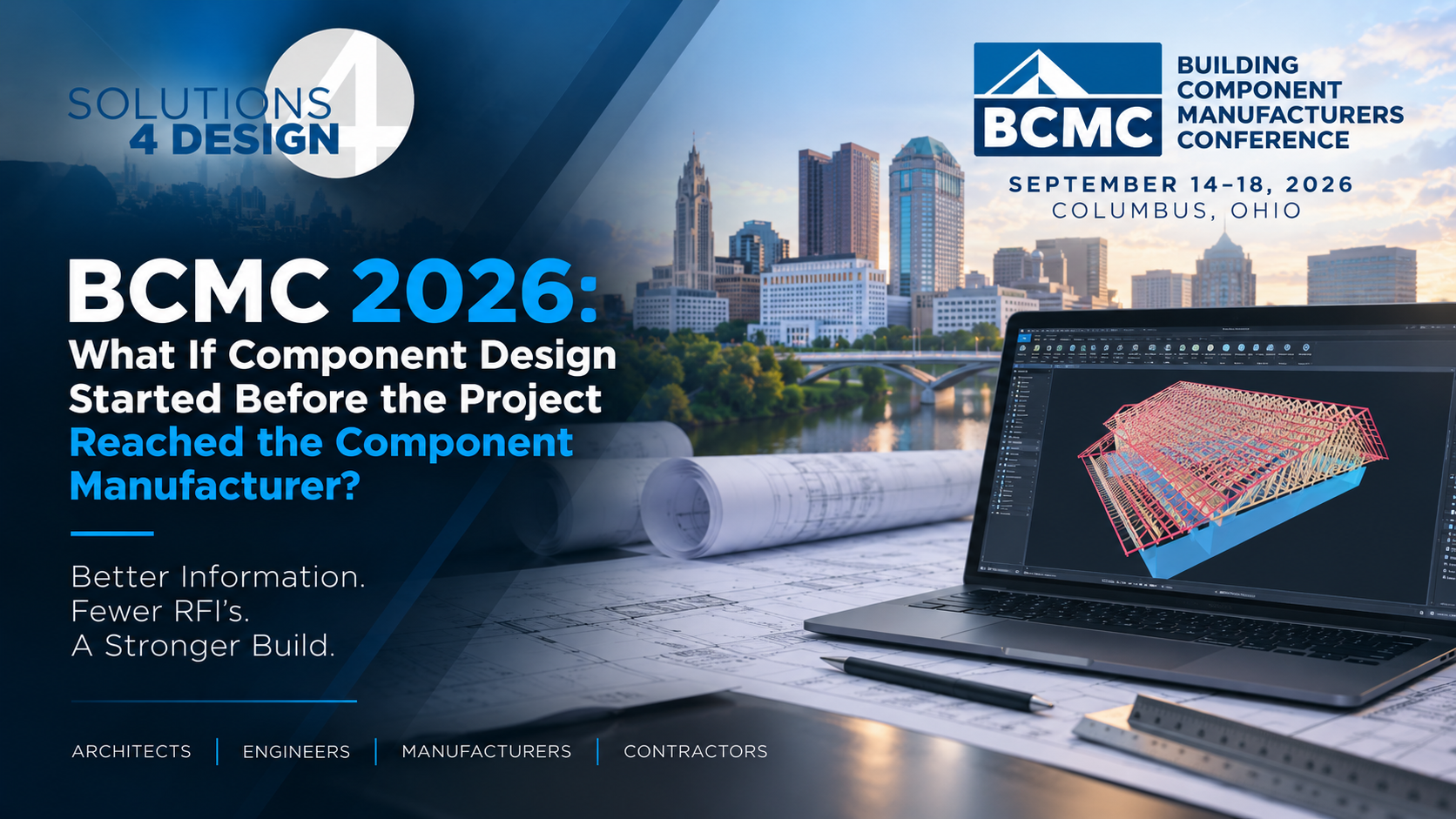
BCMC 2026: What If Component Design Started Before the Project Reached the Component Manufacturer?
As the building-component industry gathers in Columbus, Solutions 4 Design sees an opportunity to rethink where component design begins—and how architects, engineers, manufacturers, and contractors can work from better information.
BCMC Is Always About What’s Next
Every year, BCMC brings together the people, technology, equipment, and ideas shaping the structural building-component industry. This year’s conference takes place September 14–18 at the Greater Columbus Convention Center, bringing component manufacturers, framers, suppliers, technology companies, and industry professionals together to look at where the industry is headed.
A lot of that conversation naturally centers on manufacturing.
How do we produce components faster? How do we automate more of the plant? How do we improve material utilization? How do we move information from estimating through design and into production more efficiently?
Those are important questions.
At Solutions 4 Design, we’re also interested in what happens before the project reaches the component manufacturer.
Because one of the biggest opportunities for improving component manufacturing may be giving the manufacturer a better-defined project in the first place.
What If the Component Layout Was Already Coordinated?
Consider the traditional process.
An architect and engineer develop the building documents. The project is released for bidding. Multiple component manufacturers review those documents and begin developing their own interpretations of the component package.
One manufacturer may approach the roof one way. Another may use a different layout. Assumptions can differ. Structural conditions may be interpreted differently. Questions emerge, RFIs are generated, and the architect and engineer may eventually find themselves reviewing several different solutions for the same building.
Now consider a different approach.
What if the architect and engineer had greater control over the component design before the project was ever released for bidding?
Solutions 4 Design can collaborate with architects and engineers during the pre-fabrication stage to develop coordinated truss and component layouts while the building’s structural design is still being developed.
Instead of waiting for each component manufacturer to independently interpret the project, the design team can establish more of that information upfront.
Keep the Architect and Engineer in Control
This isn’t about removing component manufacturers from the design process.
It’s about giving them better information when the project reaches them.
Architects and engineers are responsible for the overall design intent of the building. Bringing component design into the conversation earlier gives them greater visibility into how roof trusses, floor systems, structural interfaces, and other components fit into that design.
It also creates an opportunity to coordinate issues such as:
- MEP conflicts
- Point-load requirements
- Tie-down conditions
- Wind-design requirements
- Bearing locations
- Structural interfaces
- Component geometry
The result can be a much more coordinated set of project documents.
From Apples-to-Oranges to Apples-to-Apples
There is another major advantage: bidding.
If three component manufacturers receive a project and each develops a different component solution, the architect, engineer, contractor, or owner isn’t necessarily comparing the same thing.
One bid may include different assumptions than another. Layouts may differ. Material requirements may differ. Engineering considerations may differ.
The lowest number doesn’t necessarily represent the same scope.
By developing and coordinating component layouts earlier, manufacturers can receive a much more clearly defined project to bid.
They’re pricing the same basic component design rather than independently developing three different interpretations.
That moves the bidding process much closer to apples-to-apples instead of apples-to-oranges.
For architects and engineers, that can mean less time reconciling competing designs.
For contractors, it can mean clearer pricing.
For manufacturers, it can mean fewer unanswered questions when the project arrives.
Reduce RFIs Before They Exist
RFIs are a necessary part of construction, but many of them are simply the result of information that wasn’t coordinated early enough.
A component designer may discover that a point load doesn’t have a clear path. A mechanical system may conflict with a structural condition. A tie-down requirement may not have been fully incorporated. Roof geometry may create a condition that requires additional coordination.
Those questions still need to be answered regardless of when they’re discovered.
The difference is when they cost the project time.
If the architect, engineer, and component design team address them during pre-fabrication design, they can often be resolved as part of the normal design process.
If they’re discovered after bidding, they become RFIs, revisions, approvals, schedule changes, and potentially production delays.
Earlier component coordination doesn’t eliminate every RFI.
But eliminating the avoidable ones can make a meaningful difference.
The Paragon Design Platform Changes What’s Possible
This is one reason Solutions 4 Design is excited about what the Paragon design platform brings to our workflow.
Paragon describes its platform as an independent, cloud-based component design and analysis environment covering estimating and layout through production-ready designs. At BCMC 2026, Paragon Components is exhibiting in Booth 821.
For Solutions 4 Design, the important part isn’t simply having another software package.
It’s what the platform allows our designers to do.
The cloud-based environment supports collaboration across geography. The platform provides flexibility across connector-plate systems and allows design information to move through different workflows. That makes it possible for Solutions 4 Design to work with architects, engineers, and component manufacturers without requiring every participant to operate inside exactly the same traditional software environment.
Paragon itself describes an approach where architects, engineers, and building designers can develop coordinated layouts before handing them to manufacturers for final site-specific truss design and optimization.
That’s closely aligned with where we believe the industry can go.
Imagine the Handoff Differently
Instead of the component manufacturer receiving architectural plans and beginning the component-design process largely from scratch, imagine receiving a project where the major component layouts have already been developed and coordinated with the architect and engineer.
- Roof geometry has been considered.
- Floor systems have been coordinated.
- Major point loads have been identified.
- MEP conflicts have been reviewed.
- Tie-down and wind-design considerations have been addressed.
- The component package fits the architectural and structural intent.
The manufacturer can then focus on what it does best: final site-specific design and optimization, production requirements, pricing, fabrication, and delivery.
That doesn’t remove expertise from the component manufacturer.
It allows that expertise to begin with better information.
Production-Ready Information Earlier in the Process
There is an even larger opportunity as these workflows mature.
Project documents can move beyond simply showing architectural intent and begin incorporating coordinated component information that is much closer to what the manufacturer ultimately needs for production.
That can improve continuity between architecture, engineering, component design, estimating, bidding, manufacturing, and construction.
Instead of information being recreated at every stage, more of the work performed upstream can continue moving downstream.
That’s where technology starts doing something more important than making design faster.
It starts connecting the project.
What This Means for Solutions 4 Design
We’re not interested in becoming another software reseller.
Solutions 4 Design is a design organization.
Our value comes from the people using the technology and the experience behind them.
With more than 30 years of experience in design, home building, construction, and the building industry—and with our expanding capabilities in truss design, Revit, AutoCAD, architectural production, material takeoffs, rendering, design management, and pre-fabrication coordination—we have an opportunity to sit between several disciplines that historically haven’t always communicated early enough.
Architects and engineers need component expertise.
Manufacturers need better project information.
Contractors need more predictable bids.
And everybody benefits when problems are solved before fabrication.
Jarred’s Perspective
“What interests me about where component design is heading is the opportunity to get involved earlier. Why should an architect or engineer have to wait until three manufacturers bid a project to see three different interpretations of the component package?
If we can work with that design team earlier, coordinate the trusses and structural components, identify potential MEP conflicts, address point loads, tie-downs, wind requirements, and other conditions, then everybody downstream starts with better information.
The Paragon design platform gives our team technology that can help make that collaboration possible. But the bigger idea is the workflow. Give architects and engineers more control upfront, give manufacturers a better-defined project to bid, reduce unnecessary RFIs, and move better information toward production.
That’s a conversation I think our industry should be having.”
The Future of Component Design May Start Earlier
BCMC is built around improving the structural building-component industry. The equipment on the show floor will continue getting faster. Automation will continue improving. Software will continue becoming more powerful.
But perhaps one of the biggest opportunities isn’t simply improving what happens inside the component plant.
It’s improving the information that reaches the plant.
If architects, engineers, component designers, manufacturers, and contractors can collaborate earlier, we can reduce guesswork, improve bidding, identify conflicts sooner, and create a more direct path from design to fabrication.
Better manufacturing starts with better information. And better information starts with better coordination.
That’s where Solutions 4 Design believes component design is heading.
BCMC 2026 — September 14–18, Columbus, Ohio



Add a comment